




For months, the same question has been circulating regarding The Odyssey, whispered among industry insiders and fans eagerly awaiting leaks: How will Christopher Nolan—the director who has made his aversion to digital technology a trademark—depict Polyphemus, the Sirens, and the gods of Olympus without finally succumbing to CGI? A poem full of monsters, nymphs, and impossible creatures seemed like the perfect opportunity to give in. The kind of situation where even the most analog of contemporary filmmakers would have had to, for the first time, yield to technology.
In the film, however, Polyphemus does not exist inside a computer: he exists on a Greek beach, six meters tall, built as a massive animatronic capable of physically interacting with Matt Damon. This is not an isolated exception: it is the almost stubborn confirmation of a philosophy that Nolan has cultivated for twenty years—one that has spanned the destruction of a real Boeing 747 for Tenet and the pyrotechnic recreation of an atomic explosion in the desert for Oppenheimer—for which the director has always maintained, with a phrase that has become almost a mantra, that he did not use a single frame of computer graphics. In this framework, technology has always been the enemy to be kept at bay, the shadow that threatens to make everything a little less real.
But this is where the story gets complicated, and this is where Nolan’s relationship with technology has truly changed: not because he has surrendered to digital, but because he has pushed in the opposite direction—toward the real—to a degree that even he had never reached before. Ever since The Dark Knight became the first blockbuster to use IMAX cameras for certain action sequences in 2008, Nolan has increased the proportion of film in his work with each subsequent movie, culminating in Oppenheimer, for which he asked Kodak to invent a 65mm black-and-white IMAX film that simply did not exist. But even then, IMAX remained confined to spectacle scenes: the camera was too heavy and too noisy for close-ups, for dialogue, for the intimacy of a speaking face.
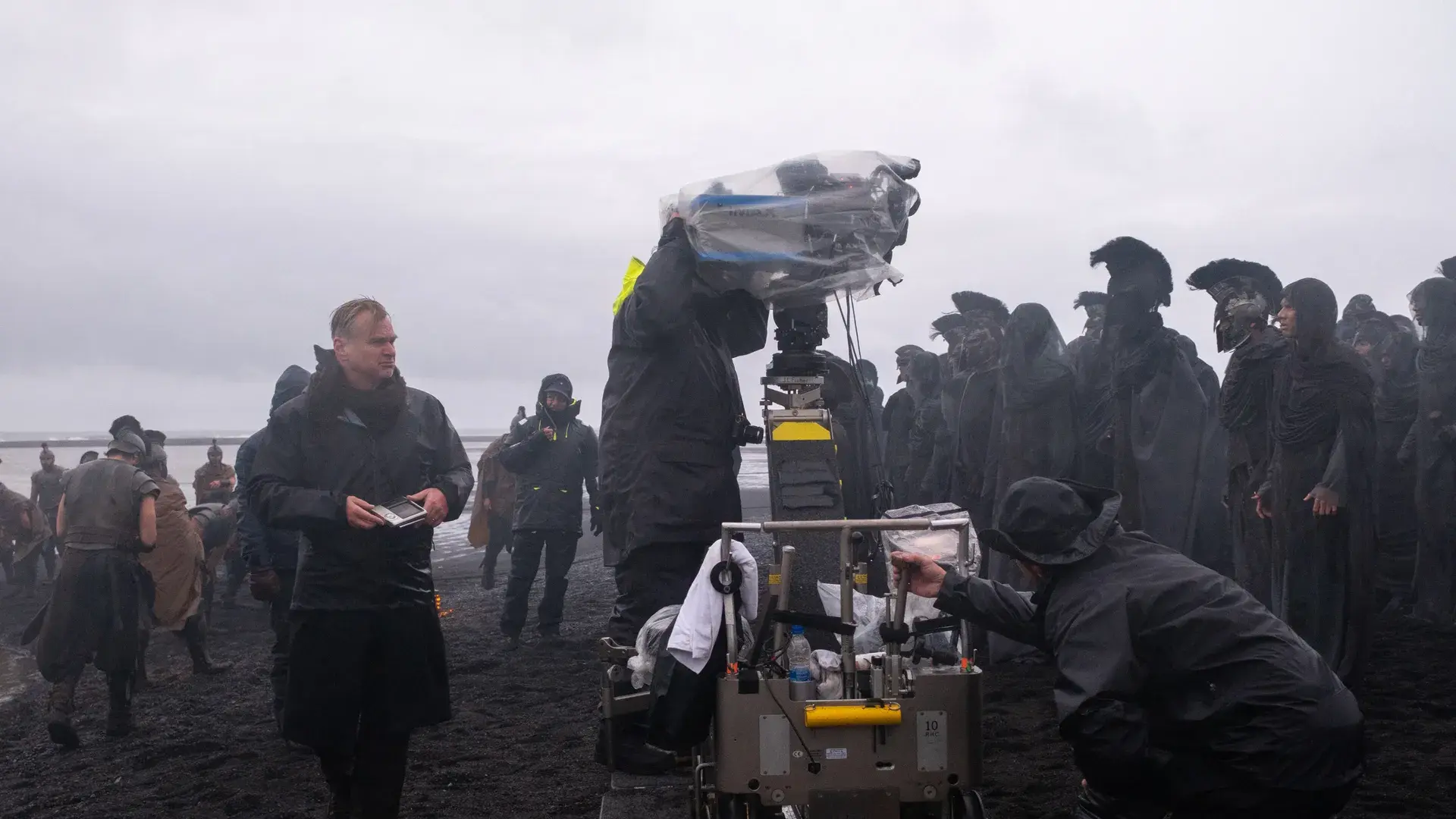
For The Odyssey, this limitation had to be eliminated. Nolan wanted an epic that would come to life through the actors’ faces as well, not just through wide shots of storms or clashing armies, and to achieve this, he commissioned IMAX to develop a completely new camera: a carbon-fiber body, a mechanism that was 30 percent quieter, and one that was finally capable of operating just a few centimeters from an actor’s face while capturing usable audio. The result is the first film in history shot entirely with IMAX cameras, from the first battle to the last whisper. Not a compromise between spectacle and intimacy, but the extension of a single tool to encompass both registers.
During production, Tom Holland recounted finding himself watching sequences he was certain had been computer-generated, only to discover—after discussing them with Nolan—that they were practical effects shot on camera. No CGI: just planning whose complexity borders on engineering. It is a testament that speaks more eloquently than any press release about what Nolan’s stubbornness means today: not the absence of technology, but technology so sophisticated that it becomes invisible, resembling a miracle of craftsmanship.
When I was studying at DAMS in Bologna several years ago, I came across a concept in many essays that the theorist André Bazin had formulated—namely, the so-called “myth of total cinema”: the idea that cinema, from its very origins, has been driven by an ambition for total realism that predates the tools capable of achieving it, and that every technical innovation (sound, color, 3D) is nothing more than a further step toward that original ideal, which has never been fully realized. Nolan applies the same mechanism, but in reverse compared to how we understand it today: whereas the industry uses technology to simulate reality in an increasingly convincing way, he uses it to avoid having to simulate it at all. He doesn’t pursue digital photorealism: he pursues reality itself, and when reality isn’t enough or isn’t available to him, he doesn’t resort to special effects but asks a company to build him a tool that doesn’t yet exist. Of course, it must be said, he is perhaps the only director in the world who can afford to do so.
In an era when American directors’ unions are openly discussing generative artificial intelligence and just how much creative work can be delegated to an automated system, this approach ceases to be merely an auteur’s whim and becomes almost a political statement. A film with a cast of that caliber, a budget of two hundred and fifty million dollars, meters and meters of exposed film shot around the world, and real locations in Morocco, Iceland, Scotland, and Sicily, is the most expensive possible declaration that cinema—to remain cinema—must still occupy space, carry weight, and require human bodies of flesh and blood. It is a camera fighting another machine—the generative one—opposing it with weight, time, and cost as its arguments.
There is, however, a contradiction worth addressing, because it complicates the picture even as it makes it more interesting. Tickets for the 70mm film screenings of The Odyssey in IMAX theaters sold out a year in advance, and that radically analog choice paradoxically translates into a luxury experience, accessible only to those who live near one of the few screens certified to reproduce it in its entirety. Defending cinema as a physical, total, unmediated experience also means creating a hierarchy between those who will be able to see it as Nolan intended and those who will simply watch it in an unequipped theater or (sigh!) via streaming, some time later.
Perhaps this is precisely the most profound aspect of the transformation: Nolan hasn’t stopped believing in technology; he’s simply reversed its function. It is no longer a tool to deceive the eye but to restore to it what it truly sees.